EN
EN


2,000 years in 2,000 steps
A journey through time in the red wine metropolis of Ahrweiler
The Ahr Valley is not just a beautiful spot on earth. It is also a living testimony to times gone by. In the red wine metropolis of Ahrweiler, guests can experience 2,000 years of history up close in just 2,000 steps. Here, Romans romped around in the best-preserved Villa Rustica beyond the Alps, brave citizen marksmen fought for their hometown on the fortified town wall in the Middle Ages and here, deep beneath the vineyards, the Federal Republic of Germany guarded what was once its most secret building during the Cold War, the government bunker.

In the footsteps of the Romans
Even the Romans appreciated the Ahr Valley with its almost Mediterranean climate and left behind a huge Villa Rustica whose state of preservation is unrivalled beyond the Alps. In the Roemervilla Museum, visitors accompany a Roman aristocratic family in their home with kitchen, private bathroom and living rooms, which was equipped with an innovative floor and wall heating system.
Medieval flair in Ahrweiler's old town centre
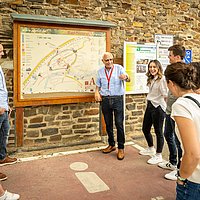
A journey back to medieval times begins just a few minutes' walk away in the centre of Ahrweiler's 13th century town walls. Anyone entering Ahrweiler's old town through one of the four mighty town gates will feel transported back to the time of knights and feudal lords, monks and merchants between narrow alleyways and half-timbered houses, battlements, market taverns, venerable noble courtyards and the imposing parish church. During the night watchman tour, guests are immersed in stories and anecdotes by the light of the evening lanterns.


Bunker complex under the vineyards
Above Ahrweiler, hidden beneath the vineyards, lies a unique historical highlight: the former government bunker of the Federal Republic of Germany. Built in the 1960s in two railway tunnels, it was a 20-kilometre-long, nuclear bomb-proof facility with an area of 83,000 square metres. Among other things, it housed a communications centre, a dentist's surgery, a television studio and the Federal Chancellor's room. Completed in 1971, the bunker offered 3,000 members of the government protection in the event of a nuclear attack. The facility was abandoned in 1997, but a section was preserved.
Since 2008, the museum has been providing an insight into this secret chapter of the Cold War with original artefacts and documentation behind the massive original roller shutters. Today, the topic is more topical than ever, so the government bunker is also a memorial to a time that people actually wanted to leave behind.
More blog posts about the Ahr valley