EN
EN


How the grape harvest works
Interesting facts about the highlight of the winegrowing year
It starts in autumn - the most exciting phase of the winegrowing year. This is because the grape harvest decides whether the winegrower's work will be rewarded with a successful wine. Now the winegrower harvests in the truest sense of the word what he has tended and nurtured throughout the year. If you visit the Ahr Valley between September and the end of October, you can watch the Ahr winegrowers at work in the vineyard in many places.
We explain how the grape harvest takes place and what significance it has for a wine-growing region like the Ahr Valley.
When is the wine ready for harvest?
As a rule, the grape harvest starts when the summer is coming to an end and the days are getting shorter, when the first grapes have reached the desired degree of ripeness. For white varieties, this begins when they change colour from green to yellow, and for red varieties from green to red-violet. During this phase, there is an increase in sugar and a decrease in acidity in the fruit. Harvesting takes place when the ideal sugar and acid content for the desired wine has been reached. To determine this point as accurately as possible, winegrowers regularly measure the must weight of the grapes from late summer onwards using a refractometer. As the grapes ripen, the sugar content in the berries increases and with it the must weight. In Germany, the must weight is given in degrees Oechsle.
When the wine is harvested depends heavily on the grape variety. There are early, medium and late ripening varieties. The harvest begins at the end of August or beginning of September with the Müller-Thurgau (also known as Rivaner) and Frühburgunder grape varieties, followed by Weißburgunder and Grauburgunder, followed by Spätburgunder, the most important grape variety in the Ahr Valley. The grape harvest finally comes to an end when the Riesling grapes are ripe. This can last until the end of October, sometimes even until the beginning of November. In a few selected vineyards, the grapes for "Spätlese" or "Auslese" wines remain on the vine even after that. The harvest for ice wines even takes place after the first heavy frosts in December or January.


What influence does the weather have?
In addition to the grape variety, the weather also plays a decisive role in the time of harvest and the quality of the grapes. This is because the quality of the grapes depends not only on the location of the vineyard, the soil conditions and the skill of the winegrower, but also to a large extent on the weather. For a good vintage, it is therefore immensely important that the weather in the respective year in which the wine was grown was as favourable as possible in all respects. This means: mild weather during flowering, a warm and long autumn and, above all, no extreme weather conditions such as heavy rain or hail.
The weather around harvest time is particularly important. If it remains sunny and dry in late summer and autumn, the harvest can be delayed a little and the quality of the grapes improved. If, on the other hand, it rains a lot, harvesting must begin early to prevent the grapes from rotting. In recent years, the first ripe grapes for the popular Federweißer and Federroter wines have already been harvested in August. The grapes for sparkling base wine are also harvested early, when they do not yet have such high Oechsle levels and still have a tingling acidity.
How do you read?
Harvesting the grapes by hand
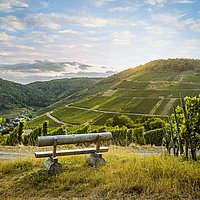
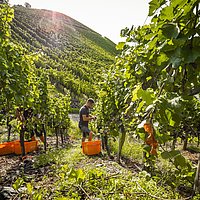
The Ahr valley is known for its rugged vineyard slopes, which are criss-crossed by slate rock. These steep slopes on the Ahr, with their optimal exposure to the sun, demand a lot from the Ahr winegrowers. This is because the steep, relatively small plots and terraced vineyards can only be harvested by hand. Machines cannot be used on the steep slopes of the valley. Every grape passes through the hands of the winegrowers!
The biggest criterion in favour of hand-picking is therefore the care with which each individual grape is harvested. The grapes are selected by hand and only the really ripe and healthy berries are cut off. Rotten and dried grapes are removed and unripe berries are left on the vine. Only the best quality grapes go into the harvest bucket. It is thanks to this care that only perfectly ripe and intact grapes can be harvested for the wines, even in difficult vintages due to the weather, such as 2021.
Advantages of manual harvesting:
- Special care
- High quality of the grapes
- Can also be used in the steepest vineyards and for single-vineyard cultivation
Challenges of hand harvesting:
- Cost-intensive, as a lot of labour is required
- More time-consuming than machine harvesting
- Physically demanding work


Harvesting with machines
If the location and slope of the vineyard allow it, most of the world's wine is now harvested with machines. Mechanical grape harvesting is carried out by a grape harvester. These sophisticated machines drive over the vines, which are planted in rows. The grapes are harvested by shaking and beating and fall into a large collecting container via a conveyor belt. During this process, leaves and small branches also end up in the grapes. Most of these are removed by a blower.
Advantages of mechanical grape harvesting:
- More cost-effective than manual harvesting
- High harvesting speed around the clock
- Can react efficiently to changes in the weather
Challenges of mechanical grape harvesting:
- High purchase price of the full harvesting machine
- hardly any selection of grapes possible, everything on the vine is harvested
- Not suitable for steep terraced vineyards such as those in the Ahr valley
- Aids for the grape harvest
What happens after the harvest?
Grapes are delicate fruit. Immediately after the harvest, the winegrowers try to transport the grapes to the winery as quickly as possible and intact. At the winery, the stems are then removed from the grapes and they are pressed.
For white wine and rosé production, the grapes are pressed fairly quickly. The red varieties first ferment on the skins for a few days, partly to extract colour from the berry skins.
The fresh wine is set and the starting signal is given for a new vintage.
We say: very good for you!


The season of wine festivals in the Ahr Valley
Let yourself be infected by our passion for our Ahr wine. Discover flavours, stories and joie de vivre - ideally at one of our wine festivals, which you can experience in the Ahr Valley in autumn. Because just like the Ahr wine, our wine events are inextricably linked to our home, the Ahr Valley.
Sample a glass or two of Ahr wine in a relaxed atmosphere with friends, which you can get directly from the winegrower and enjoy where the wine grows. Perhaps you have also watched the winegrowers in the vineyard during the harvest or even helped with the harvest yourself. This makes the wine taste twice as good.
More blog posts about the Ahr valley