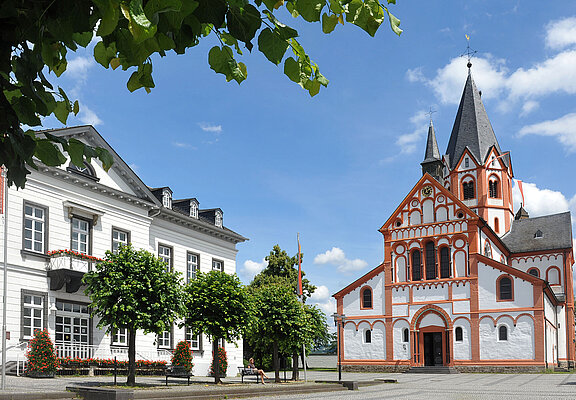
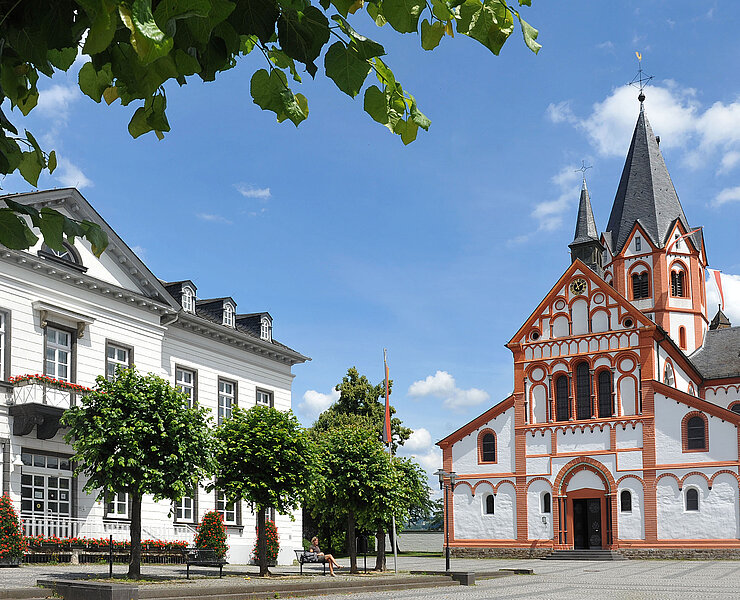
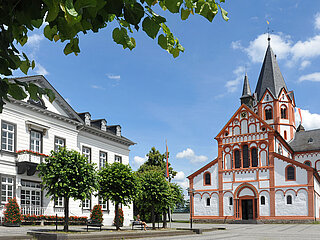
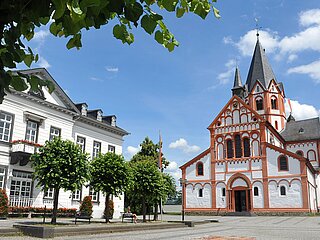
One of the outstanding sacred buildings of the late Romanesque period in the Rhineland is the parish church of St Peter, which dates back to the Staufer period. The striking similarity with other Staufer churches is unmistakable. One common feature is the octagonal ground plan of the church towers, which goes back to the Palatine Chapel of Aachen Cathedral. This octagonal floor plan served to make strangers realise from afar who was in charge in the city. Art historians date the start of construction of the Sinzig church to 1225, and the consecration of St. Peter's took place on 15 August 1241.
In addition to the church, today's town hall dominates the architecture of Sinzig's church square.
Sinzig was granted town charter in 1267, although there is no record of a town hall at this time. The neoclassical building was constructed between 1834 and 1837 as the mayor's office, district court and school. From 1936, it was used exclusively for educational purposes. It has housed the town hall since 1989. Today's council chamber is decorated with documents that illustrate the great importance of the "Sinzig Imperial Estate" and the "depth of the town's history". The town archive of the local history museum holds around 140 photographs of Sinzig's most important documents.
In front of the town hall, the Sinzig town coat of arms was embedded in the pavement in 2008 at the suggestion of pupils from Rhein-Gymnasium. The artist couple Anja von Becker and Roland Lirk created the coat of arms from various ceramic segments. The ensemble is completed by the names of the districts of Sinzig.
 EN
EN